
Electrospinning Machines

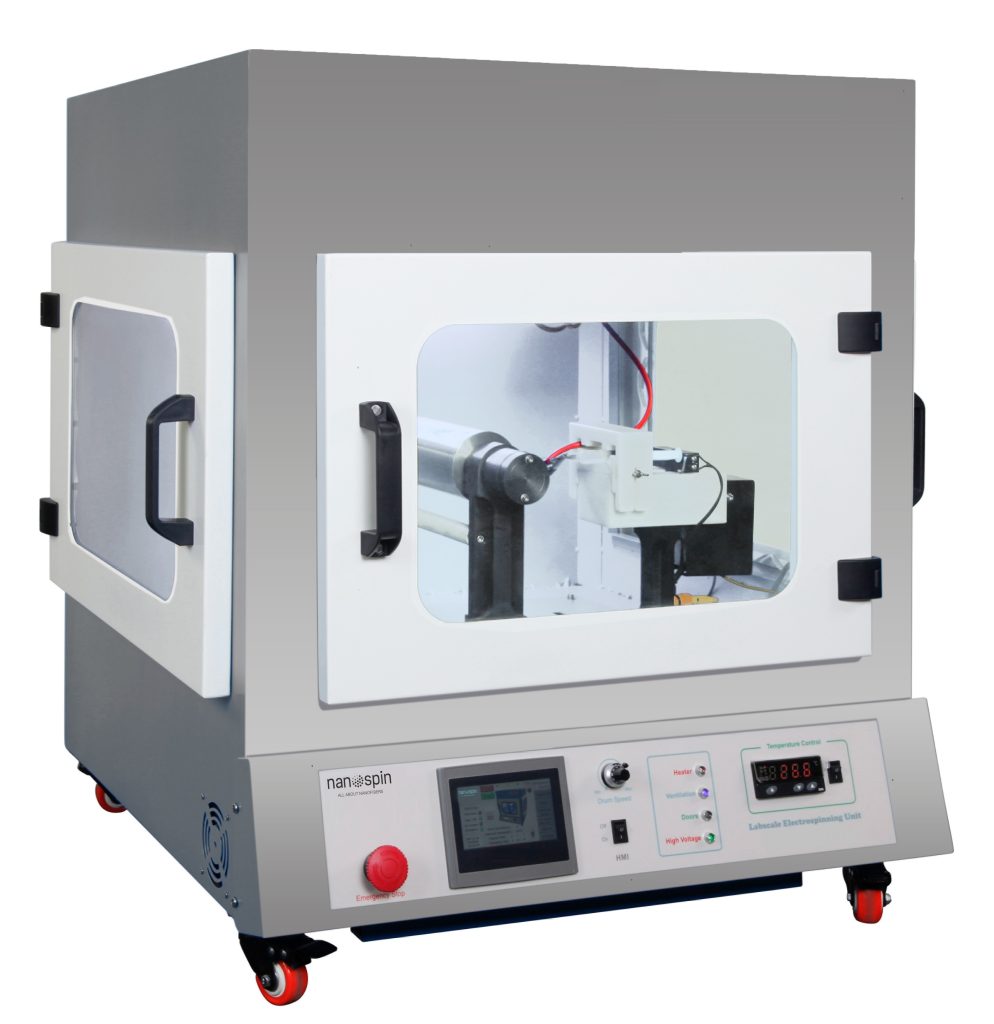
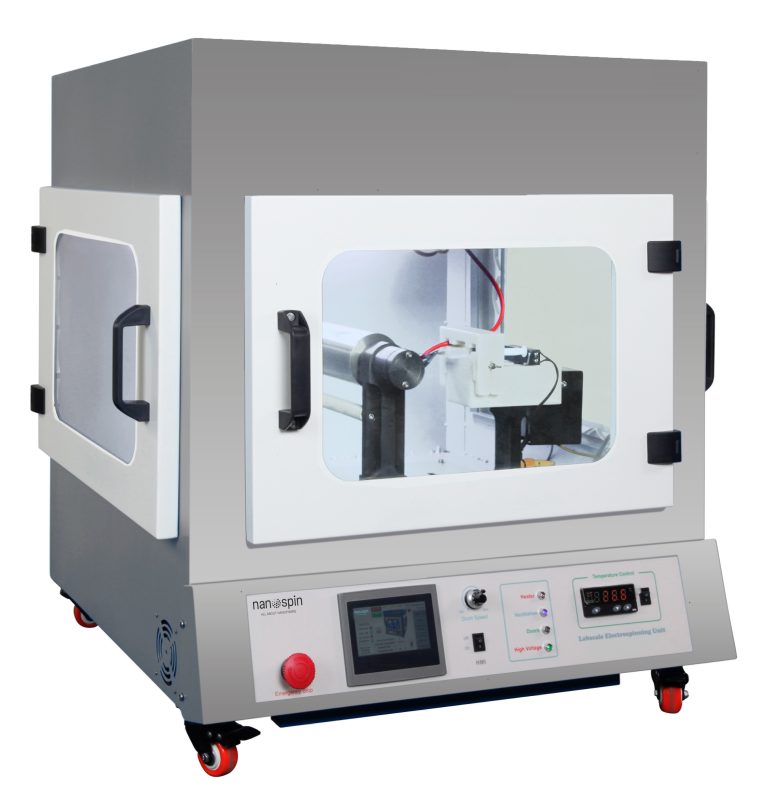
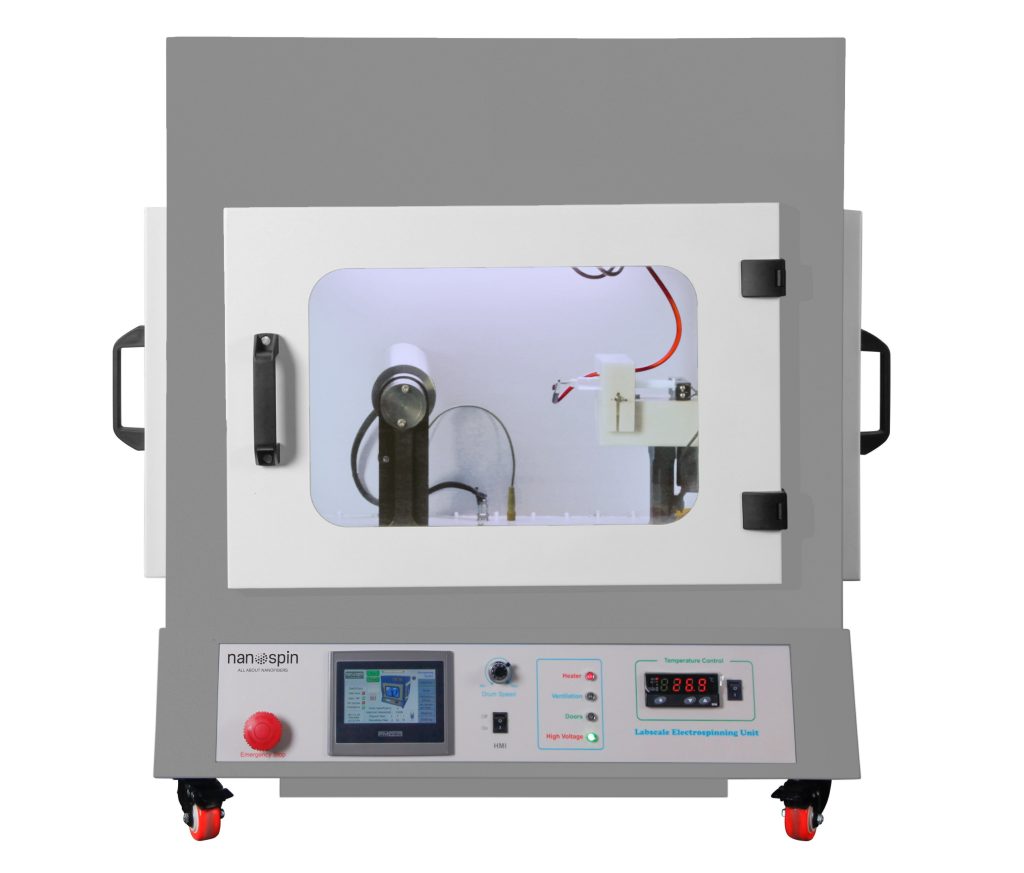
NanoSpin 10
(Single-Pump Electrospinning Machine)

NanoSpin 10

Brife Description

The NanoSpin 10 is a high-precision lab-scale electrospinning machine designed for producing polymeric, carbon, and ceramic nanofibers with diameters from 50 nm to a few microns. It is perfect for R&D and small-scale production, delivering stable performance and fine process control.

The system integrates a high-voltage power supplysyringe pumpneedlecollector, and linear motion system. The polymer solution is loaded into a syringe and ejected through a needle under high voltage, forming a nanofiber jet that is deposited on a rotating or stationary collector.


Main Feachers

Advanced Safety Features

Protects both user and system.

Modular Design

Flexible setup for various applications.

7” Touchscreen HMI

Simple control of all process parameters.

Syringe Pump System

Supports up to 2 syringes for versatile material processing.

Scanning System

Adjustable 0–3000 mm/min, 0–25 cm range

Adjustable Distance

 Adjustable from 5–20 cm.

Minimal Dead Volume

 Direct-injection pump

High Voltage System

Two supplies: 1 positive and 1 negative polarity.

Customizable Collectors

 Compatible with multiple collector types.

Red Laser Guide

Visualize nanofiber jets during operation

Specification

General
  • Chassis & Control System

    • Material: Metallic body with three access doors
    • Power input: 100-240 V AC / 50-60 Hz
    • Control system: 7” touch-screen HMI (Programmable Logic Controller

    Dimensions & Weight

    • Machine dimensions (L×W×H): 88 cm × 76 cm × 87 cm
    • Package dimensions (L×W×H): 90 cm × 95 cm × 100 cm
    • Weight: 100 kg (Package: ~140 kg)

    Safety features

    • Automatic voltage cut-off in case of door opening, grounding issues, or process disruption
  • Start and end position of the nozzle(s)
  • Injection rate control for syringe pump(s)
  • Electrospinning distance settings
  • Process timing (start, stop, and duration)
  • ON/OFF timer for exhaust fan
  • Rotational speed control of collector
  • Temperature control
  • Alarm notification for solution depletion
  • Optional digital camera for real-time process monitoring
  • 1 Red Laser to observe the nanofibers jets
  •  
  • Horizontal setup (no need for tubing)
  • Injection rate: 50 µl/h to 500 ml/h
  • Usable syringe size: 1–25 mm (inner diameter)
  • Optional: Co-axial nozzle with tubing
  • Scanning Rate: 0-30 mm/s (adjustable)
  • Scanning Range: 0-30 cm (adjustable)
  • Model: PS35 Positive & PS35 Negative
  • Max. Output Voltage: 35 kV
  • Power Consumption: 30 W
  • Voltage Monitoring: Digital display, accuracy: 0.1 kV
  • Connections:
    • One positive high-voltage power supplies linked to syringe pumps
    • One negative high-voltage power supply linked to the collector
  • Specifications

    • Negative cylinder & plate collector
    • Optional collectors: Wire, mandrel, single wire, radial, needle, and disk collectors
    • Material: Stainless steel
    • Rotational speed: 300–3000 rpm (cylindrical drum)
    • Spinning distance: 5–20 cm
    • Nanofiber coverage area: 30 cm × 29 cm (Cylindrical drum)

    Collector Dimensions

    • Negative Cylindrical Collector: 10 cm (ø) × 29 cm (L)
    • Plate Collector: 30 cm × 30 cm
    • Single Wire Collector (Optional): Tensioned cable (20+ µm cables)
    • Needle Collector (Optional): Replaceable needle
    • Disk Collector (Optional): Diameter: 3, 5, & 10 cm
    • Wheel Collector (Optional): Diameter: 20 cm, Thickness: 1, 2, & 4 cm
    • Mandrel (Optional): Length: 25 cm, Diameter: 2, 4, 6, 8, & 10 mm

    All collectors can be attached to a negative high-voltage power supply (-35 kV)

  • Ventilation

    • Programmable fan, adjustable via HMI panel

    Atmospheric Control System (Optional)

    • Heating system: Adjustable up to 45°C (±1°C)
    • Cooling system: Temperature reduction down to 19°C (±1°C)
    • Humidifier: Up to 80%
    • Dehumidifier: Down to 15% (±5%)

    Environmental Requirements

    • Operating temperature: 20–30°C
    • Operating humidity: 20–70%

Lab-scale electrospinning with the NanoSpin 10 allows researchers to study how parameters such as flow ratevoltagecollector speed, and spinning distance influence nanofiber morphology.
Common uses include:

🩹 Tissue Engineering – Scaffolds and regenerative materials.

💊 Drug Delivery – Controlled release systems.

⚗️ Catalysis – High-surface-area catalytic supports.

🌬️ Filtration – Air and liquid nanofiber membranes.

🩹 Biomedical Research – Wound dressings, tissue engineering.

🔋 Energy Storage – Battery separators and related materials.

📡 Nanofiber Sensors – Sensitive detection and measurement systems.

👕 Textile & Composites – Advanced fabrics and reinforcement materials.